

Tour Type
Mountain Climbing
Tour Duration
8 Days 7 Nights
Min. No of Pax
1
Tour Price
Budget
On request
Mid-range
On request
Luxury
On request
The Price Includes
- Airport pickup from Kilimanjaro International Airport
- Departure airport transfer
- Two nights hotel accommodation in Arusha
- Bed and breakfast accommodation in Arusha
- Transportation from Arusha to Marangu Gate
- Transportation from Marangu Gate back to Arusha
- Kilimanjaro National Park entry fees
- Kilimanjaro conservation fees
- Kilimanjaro hut accommodation fees
- Kilimanjaro rescue fees
- Applicable government taxes
- Professional licensed Kilimanjaro mountain guide
- Assistant guides according to group size
- Professional mountain cook
- Porters for group equipment and permitted personal luggage
- Mountain crew salaries
- Permanent mountain hut accommodation
- Three meals per day while on the mountain
- Safe drinking water during the mountain climb
- Cooking equipment
- Group mountain equipment
- Pre climb briefing in Arusha
- Trekking equipment inspection
- National park registration assistance
- Basic first aid support
- Regular general health and altitude monitoring
- Summit preparation briefing
- Official summit certificate for eligible climbers
- All services specifically mentioned in the confirmed itinerary
The Price Excludes
- International flights
- Domestic flights unless specifically included
- Tanzania entry visa
- Passport expenses
- Travel insurance
- High altitude trekking insurance
- Emergency medical evacuation insurance beyond standard park arrangements
- Personal trekking clothing
- Hiking boots
- Sleeping bag unless specifically included
- Trekking poles unless specifically included
- Personal daypack
- Personal duffel bag unless provided
- Personal medication
- Vaccinations
- Medical consultations
- Alcoholic beverages
- Bottled soft drinks
- Laundry services
- Telephone calls
- Internet expenses
- Personal shopping
- Souvenirs
- Optional activities in Arusha
- Tanzania safari extensions
- Zanzibar extensions
- Additional hotel nights not listed in the itinerary
- Meals in Arusha except those stated
- Tips for guides, assistant guides, cooks, and porters
- Expenses caused by illness
- Costs caused by early mountain descent
- Expenses caused by flight delays or cancellations
- Personal equipment rental unless specifically included
- Services not clearly listed under Price Includes
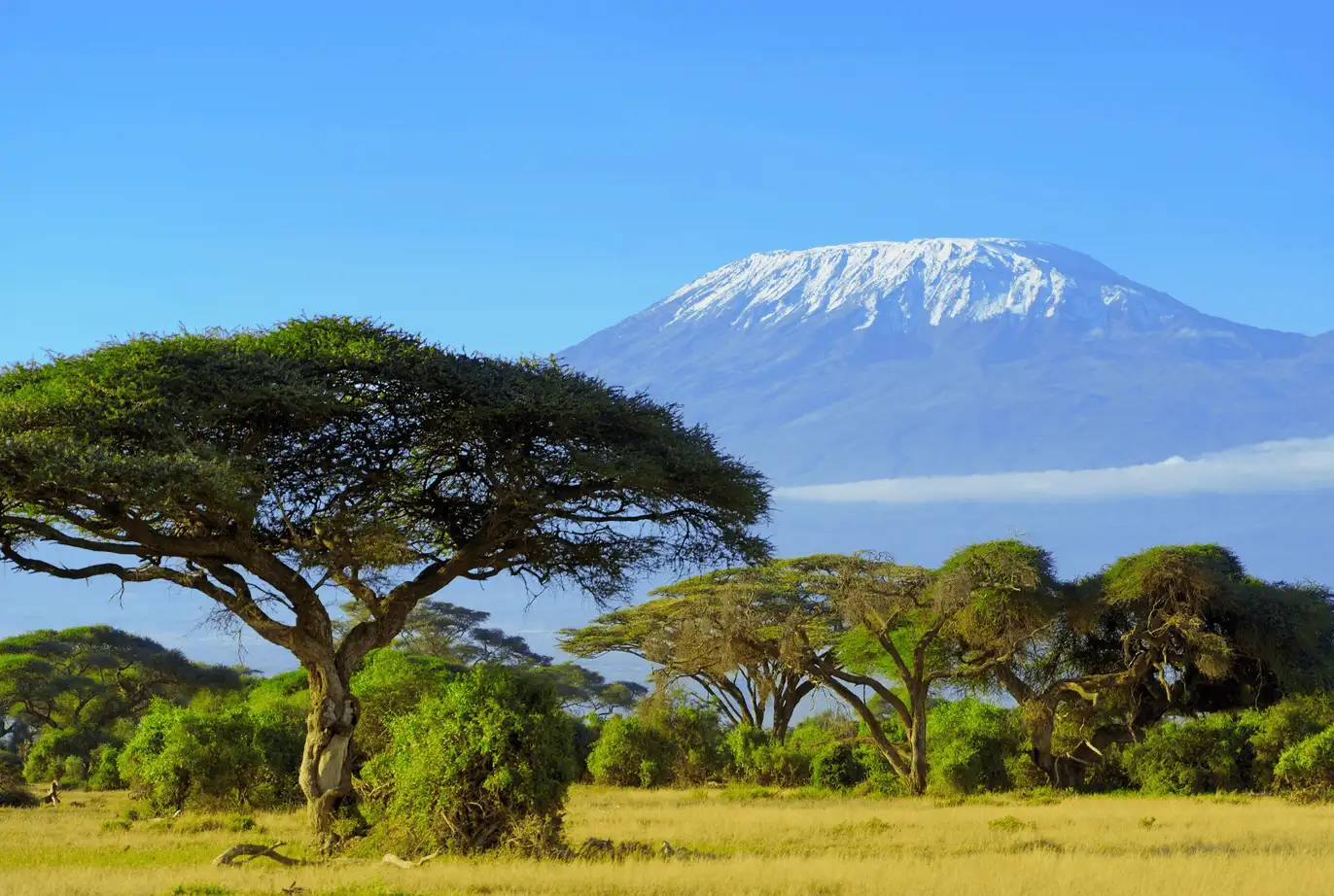
Tour Overview
The 8 Days Marangu Route with 6 Days Hiking is one of the most classic and well established ways to climb Mount Kilimanjaro, the highest mountain in Africa. This itinerary is designed for travelers who want a structured trekking experience with permanent mountain hut accommodation, gradual altitude progression, beautiful views of Mawenzi and Kibo, and an important acclimatization day before the final ascent toward the summit.
Organized by Woodland Trek & Safaris, a professional tour company based in Arusha, Tanzania, this package includes one arrival day, six actual mountain trekking days, and one departure day. It offers a complete Kilimanjaro experience from the green lower slopes around Marangu Gate to the arctic summit environment surrounding Uhuru Peak at 5,895 metres or 19,341 feet above sea level.
The Marangu Route approaches Mount Kilimanjaro from the southeastern side. It is particularly famous because it is the only major Kilimanjaro route where climbers sleep in permanent mountain huts rather than tents.
This makes it an attractive option for trekkers who prefer sleeping inside simple shared mountain shelters instead of camping every night.
The route begins at Marangu Gate, where Kilimanjaro National Park registration is completed before the trek starts.
From the gate, the trail enters a lush montane rainforest filled with tall trees, giant ferns, moss, flowers, vines, and rich birdlife.
The first hiking day leads to Mandara Hut, situated at approximately 2,720 metres above sea level.
This initial section is relatively moderate compared with the higher stages, making it a good introduction to the mountain.
The following day, you leave the rainforest and continue toward Horombo Hut, climbing through heath and moorland.
The landscape becomes more open, and the views of the mountain become increasingly dramatic.
On clear days, both Mawenzi Peak and Kibo may appear ahead.
Horombo Hut sits at approximately 3,720 metres and is one of the most important locations on the Marangu Route.
Because this itinerary includes six hiking days, you will spend two nights at Horombo.
The additional day is used for acclimatization and normally includes a hike toward Zebra Rocks or another suitable high altitude point before returning to Horombo for a second night.
This extra acclimatization day is one of the key advantages of the six day Marangu programme.
The body needs time to adjust as atmospheric pressure decreases and oxygen becomes less available.
Climbing higher during the day before returning to sleep lower can help the body adapt gradually.
No itinerary can guarantee that altitude sickness will not occur, but additional time on the mountain generally provides a better acclimatization opportunity than a rushed ascent.
After Horombo, the route continues toward Kibo Hut, crossing one of the most impressive landscapes on Kilimanjaro.
The trail passes through the high altitude saddle between Mawenzi and Kibo.
This area is broad, dry, exposed, and almost lunar in appearance.
Vegetation becomes extremely limited.
Mawenzi rises dramatically on one side while Kibo dominates the horizon ahead.
Kibo Hut stands at approximately 4,703 metres above sea level and is the final resting point before the summit attempt.
After arriving, climbers eat, hydrate, prepare their summit clothing, and rest.
The summit ascent normally begins around midnight.
The route climbs slowly through darkness over steep volcanic scree toward Gilman’s Point, which is located on the crater rim at approximately 5,685 metres.
This is one of the most physically and mentally demanding sections of the trek.
The combination of high altitude, freezing temperatures, steep terrain, darkness, and fatigue makes every step important.
From Gilman’s Point, climbers who are physically safe to continue follow the crater rim toward Uhuru Peak.
The final approach is less steep but takes place at extreme altitude.
Glaciers, volcanic terrain, snow, ice, and the enormous crater landscape create unforgettable views.
Eventually, you reach Uhuru Peak at 5,895 metres, the highest point on Mount Kilimanjaro and the highest point on the African continent.
Standing at Uhuru Peak is the defining moment of the expedition.
For many travelers, reaching the summit represents the reward for months of preparation, days of slow hiking, cold nights, high altitude challenges, and the determination to continue.
Time at the summit is normally limited because of the cold and reduced oxygen.
After photographs and a short celebration, you descend back toward Kibo Hut and continue further down to Horombo Hut.
The descent is long but brings warmer temperatures and increasing oxygen levels.
The final hiking day continues from Horombo through Mandara and back to Marangu Gate.
The vegetation becomes greener and denser as you descend.
At Marangu Gate, the national park exit procedures are completed and eligible climbers receive their official summit certificates.
You then return to Arusha for a well deserved shower, comfortable hotel, and celebration.
The Marangu Route is often informally called the Coca Cola Route because of its history, popularity, and established hut infrastructure.
However, this nickname should never be interpreted to mean that the route is easy.
Mount Kilimanjaro is a serious high altitude mountain.
The main challenge is not technical climbing but the combination of altitude, long trekking days, cold weather, physical fatigue, and summit night.
The Marangu Route is generally more direct than some other Kilimanjaro routes.
For this reason, acclimatization is especially important.
The additional day at Horombo makes this six day itinerary more suitable than the shorter five day version for many trekkers.
One of the greatest attractions of the route is its ecological diversity.
During the climb, you pass through several distinct vegetation zones.
The lower slopes are covered by humid montane rainforest.
Higher up, the forest transitions into open heath and moorland.
Above this lies the alpine desert, where vegetation becomes rare.
The summit area becomes an arctic environment of rock, ice, snow, and freezing winds.
This transformation is one of the reasons Mount Kilimanjaro is such a unique trekking destination.
You begin in a green tropical environment and finish among glaciers near 6,000 metres above sea level.
Mount Kilimanjaro itself is formed by three principal volcanic cones known as Shira, Mawenzi, and Kibo.
Shira is the oldest and most heavily eroded.
Mawenzi is rugged and jagged, creating one of the most dramatic peaks visible from the Marangu Route.
Kibo is the highest cone and contains Uhuru Peak.
The route between Horombo and Kibo provides some of the best views of Mawenzi.
The broad Saddle separating Mawenzi from Kibo gives climbers a powerful sense of the size of the mountain.
The Marangu Route is especially suitable for climbers who want a classic Kilimanjaro experience with hut accommodation, established trails, a straightforward ascent, and a dedicated acclimatization day.
It is popular among solo travelers, couples, private groups, families with appropriate fitness, charity teams, and travelers completing Kilimanjaro as a personal milestone.
Physical preparation is strongly recommended.
Useful training includes long walks, stair climbing, hiking on hills, cardiovascular exercise, leg strengthening, and walking with a loaded daypack.
The more comfortable you become with several consecutive hours of walking, the better prepared you will be for the mountain.
Mental preparation is equally important.
Your guides will repeatedly encourage you to walk pole pole, meaning slowly, slowly in Swahili.
This phrase is one of the most important principles of Kilimanjaro climbing.
Walking slowly conserves energy and supports altitude adaptation.
Reaching the summit is not about speed.
It is about patience, consistency, hydration, nutrition, and listening to your guide.
Throughout the expedition, you will be supported by the experienced mountain team of Woodland Trek & Safaris.
Depending on group size, the team may include a lead mountain guide, assistant guides, porters, and mountain cooks.
The crew helps transport luggage and supplies, prepare meals, manage mountain logistics, monitor climbers, and provide encouragement throughout the trek.
The mountain team is one of the most important parts of the Kilimanjaro experience.
You share long hiking days, meals, stories, songs, challenges, and summit dreams with the people who know the mountain deeply.
The 8 Days Marangu Route with 6 Days Hiking is therefore not simply a route to the summit.
It is a complete journey through the landscapes, ecosystems, culture, and high altitude environment of Mount Kilimanjaro.
With Woodland Trek & Safaris, your adventure begins in Arusha, climbs through the southeastern slopes of the mountain, and leads all the way to the Roof of Africa.
Essential Tour Information
- Total itinerary duration: 8 days and 7 nights
- Actual mountain hiking duration: 6 days and 5 nights
- Starting city: Arusha, Tanzania
- Mountain starting point: Marangu Gate
- Mountain finishing point: Marangu Gate
- Route: Marangu Route
- Highest point: Uhuru Peak at 5,895 metres or 19,341 feet
- Highest sleeping point: Kibo Hut at approximately 4,703 metres
- Approximate total trekking distance: 70 to 75 kilometres
- Difficulty level: Challenging high altitude trek
- Technical climbing required: No conventional technical climbing normally required
- Mountain accommodation: Permanent mountain huts
- Accommodation before and after climbing: Hotel in Arusha
- Recommended fitness: Good physical fitness and trekking preparation
- Main ecological zones: Rainforest, heath, moorland, alpine desert, and arctic summit zone
- Main acclimatization location: Horombo Hut
- Main summit approach: Kibo Hut through Gilman’s Point
- Main visible peaks: Kibo and Mawenzi
- Best suited for: Climbers looking for hut accommodation and a classic Kilimanjaro route
Why Choose the 6 Day Marangu Route
Permanent Mountain Hut Accommodation
The Marangu Route is unique because it uses permanent mountain huts instead of tented camps.
You sleep at Mandara Hut, Horombo Hut, and Kibo Hut.
This can be especially appealing to trekkers who prefer a simple sheltered sleeping environment.
Dedicated Acclimatization Day
This six day version includes an additional day at Horombo Hut.
The acclimatization hike allows you to gain extra altitude before returning to sleep at the lower hut.
Historic Kilimanjaro Route
Marangu is one of the oldest and most established Kilimanjaro trekking routes.
It has a long mountaineering history and remains one of the most recognizable climbing trails in Tanzania.
Beautiful Mawenzi Views
The route provides excellent views toward the rugged Mawenzi volcanic cone.
Mawenzi creates a dramatic contrast with the broad slopes of Kibo.
Straightforward Trail
The Marangu Route follows a clear and direct path toward the summit.
The same general route is used for both ascent and descent.
Diverse Landscapes
Within only a few days, you move from rainforest to moorland, alpine desert, and finally the arctic summit environment.
Day To day
DAY 1 ARRIVAL AT KILIMANJARO INTERNATIONAL AIRPORT AND TRANSFER TO ARUSHA
Location: Kilimanjaro International Airport and Arusha
Approximate driving distance: 50 to 55 kilometres
Approximate travel time: 1 to 1.5 hours
Elevation in Arusha: Approximately 1,400 metres or 4,593 feet
Major activities: Airport reception, hotel transfer, mountain briefing, equipment check, and preparation
Welcome to Tanzania and the beginning of your 8 Days Marangu Route Kilimanjaro climbing adventure.
After arriving at Kilimanjaro International Airport, you will complete the necessary immigration and baggage procedures before meeting a representative from Woodland Trek & Safaris.
From the airport, you travel toward Arusha.
The drive normally takes around one to one and a half hours depending on traffic and your hotel location.
Arusha is one of the major tourism centres in northern Tanzania and an important gateway to Mount Kilimanjaro, Mount Meru, Serengeti National Park, Ngorongoro Crater, Tarangire National Park, and Lake Manyara National Park.
After checking into your hotel, you will have time to rest.
Later, you meet your mountain guide for a detailed pre climb briefing.
The guide explains the complete Marangu itinerary, the daily hiking distances, expected altitudes, hut accommodation, meals, weather conditions, luggage regulations, health monitoring, and summit procedures.
Your trekking equipment is also inspected.
Your guide may check:
- Hiking boots
- Waterproof jacket and trousers
- Thermal layers
- Warm jacket
- Warm gloves
- Sleeping bag
- Trekking poles
- Headlamp
- Sunglasses
- Sun protection
- Daypack
- Hydration system
- Personal medication
If necessary, missing equipment may be rented or purchased in Arusha depending on availability.
The remainder of the evening should be used for rest, hydration, and luggage organization.
Tomorrow, the mountain adventure begins.
Extra Activities in Arusha
- Explore Arusha city centre
- Visit local craft markets
- Visit the Cultural Heritage Centre
- Enjoy an optional coffee experience
- Purchase or rent trekking equipment
- Relax at the hotel
- Meet your climbing group
- Review your mountain gear
- Exchange money for personal expenses and tips
Accommodation: Hotel in Arusha
Meals: Bed and breakfast
DAY 2 ARUSHA TO MARANGU GATE AND TREK TO MANDARA HUT
Starting location: Arusha
Mountain entrance: Marangu Gate
Destination: Mandara Hut
Approximate driving distance: 120 to 130 kilometres
Approximate driving time: 2.5 to 3 hours
Approximate trekking distance: 8 kilometres
Approximate hiking time: 4 to 5 hours
Starting elevation at Marangu Gate: Approximately 1,860 metres or 6,102 feet
Sleeping elevation at Mandara Hut: Approximately 2,720 metres or 8,924 feet
Approximate elevation gain: 860 metres
Vegetation zone: Montane rainforest
Major activities: Kilimanjaro registration, rainforest trekking, birdwatching, wildlife observation, and hut accommodation
After breakfast in Arusha, you leave the city and travel toward the Kilimanjaro region.
The drive to Marangu Gate normally takes approximately two and a half to three hours.
The road passes through towns, villages, agricultural areas, coffee farms, banana plantations, and fertile lower mountain slopes.
Upon arriving at Marangu Gate, your guide completes the required Kilimanjaro National Park registration procedures.
The mountain crew organizes food, supplies, group equipment, and porter loads.
Once registration is complete, your climb officially begins.
The trail immediately enters the beautiful montane rainforest.
Today’s trek is approximately 8 kilometres and normally takes four to five hours.
The forest is thick, humid, and green.
Tall trees form a canopy above the trail.
Ferns, mosses, vines, wildflowers, and other vegetation surround the path.
The lower mountain receives significant moisture, so the trail can become wet and muddy.
Trekking poles can be useful, especially during rainy periods.
Wildlife sightings are not guaranteed, but the forest may contain blue monkeys, black and white colobus monkeys, birds, and small mammals.
Your guide will maintain a slow and steady pace.
The first day is not about speed.
It is about establishing a comfortable mountain rhythm.
Eventually, you reach Mandara Hut at approximately 2,720 metres above sea level.
After arriving, you settle into your sleeping area and enjoy a warm meal.
If time and weather allow, you may complete an optional walk toward Maundi Crater.
The crater provides a good introduction to the volcanic geology of Kilimanjaro and may offer beautiful views.
Extra Activities at Mandara Hut
- Optional Maundi Crater walk
- Forest photography
- Birdwatching
- Monkey observation
- Short acclimatization walk
- Guided stretching
- Nature interpretation
- Evening mountain briefing
- Photography of Kilimanjaro’s rainforest
Accommodation: Mandara Hut
Meals: Breakfast, lunch, and dinner
DAY 3 MANDARA HUT TO HOROMBO HUT
Starting point: Mandara Hut
Destination: Horombo Hut
Approximate trekking distance: 12 kilometres
Approximate hiking time: 6 to 8 hours
Starting elevation: Approximately 2,720 metres
Sleeping elevation: Approximately 3,720 metres or 12,205 feet
Approximate elevation gain: 1,000 metres
Vegetation zones: Rainforest, heath, and moorland
Major activities: Long ascent, moorland trekking, Mawenzi viewing, Kibo views, and acclimatization
After breakfast at Mandara Hut, you continue your ascent toward Horombo Hut.
Today is longer and more demanding than the first trekking day.
The route covers approximately 12 kilometres and usually takes between six and eight hours.
Shortly after leaving Mandara, the dense rainforest begins to disappear.
The landscape opens into heath and moorland.
Tall trees are replaced by shrubs, heathers, grasses, wildflowers, and volcanic rocks.
The broader environment allows impressive views across the surrounding mountain slopes.
On clear days, Mawenzi Peak becomes increasingly visible.
Its jagged volcanic ridges create one of the most dramatic views on the Marangu Route.
Kibo may also appear ahead.
The trail climbs gradually but consistently.
As the elevation increases, breathing becomes more noticeable.
Your guides will continue encouraging the slow pole pole pace.
Hydration is important because the environment becomes drier than the rainforest.
Eventually, you arrive at Horombo Hut at approximately 3,720 metres above sea level.
Horombo is one of the largest hut areas on Kilimanjaro.
Climbers moving upward and trekkers descending from the summit may both use the location.
After arriving, you will rest, eat, hydrate, and prepare for the acclimatization day.
The increase in altitude from Mandara to Horombo is significant.
You should communicate openly if you experience headache, nausea, dizziness, unusual fatigue, or loss of appetite.
Extra Activities at Horombo Hut
- Mawenzi photography
- Kibo viewing
- Sunset photography
- Short acclimatization walk
- High altitude vegetation observation
- Guided stretching
- Breathing exercises
- Altitude health assessment
- Evening mountain briefing
Accommodation: Horombo Hut
Meals: Breakfast, lunch, and dinner
DAY 4 HOROMBO ACCLIMATIZATION DAY AND ZEBRA ROCKS HIKE
Starting point: Horombo Hut
Main acclimatization destination: Zebra Rocks
Return destination: Horombo Hut
Approximate trekking distance: 5 to 8 kilometres
Approximate hiking time: 3 to 5 hours
Starting elevation: Approximately 3,720 metres
Approximate Zebra Rocks elevation: Around 4,000 metres
Possible highest elevation: Approximately 4,000 to 4,200 metres
Sleeping elevation: Approximately 3,720 metres
Vegetation zone: Moorland and alpine transition
Major activities: High altitude acclimatization, Zebra Rocks visit, photography, recovery, and mountain preparation
Today is one of the most important days in the 6 Day Marangu Route itinerary.
Instead of continuing immediately toward Kibo Hut, you remain at Horombo for a second night.
After breakfast, your guide assesses the group before beginning an acclimatization hike.
The most common destination is Zebra Rocks, a striking rock formation with natural dark and light mineral patterns.
The round trip normally covers approximately 5 to 8 kilometres and takes between three and five hours.
The purpose of the hike is not distance.
The purpose is to gain additional altitude before returning to sleep lower.
This is an important high altitude acclimatization principle.
As you climb above Horombo, vegetation becomes increasingly sparse.
The landscape opens toward Mawenzi.
The rugged mountain formation creates an impressive backdrop.
Depending on the route selected and your physical condition, you may climb slightly above Zebra Rocks before returning.
After spending time at the higher elevation, you descend back to Horombo Hut.
The remainder of the day is used for rest, hydration, nutrition, and equipment preparation.
This extra night provides valuable time before tomorrow’s climb toward Kibo Hut.
Extra Activities During the Acclimatization Day
- Zebra Rocks visit
- High altitude photography
- Mawenzi viewing
- Guided acclimatization walk
- Geological interpretation
- Breathing exercises
- Guided stretching
- Hiking boot and blister care
- Summit equipment review
- Hydration planning
- Altitude health monitoring
- Sunset viewing
Accommodation: Horombo Hut
Meals: Breakfast, lunch, and dinner
DAY 5 HOROMBO HUT TO KIBO HUT
Starting point: Horombo Hut
Destination: Kibo Hut
Approximate trekking distance: 10 kilometres
Approximate hiking time: 6 to 8 hours
Starting elevation: Approximately 3,720 metres
Sleeping elevation: Approximately 4,703 metres or 15,430 feet
Approximate elevation gain: 983 metres
Vegetation zones: Moorland and alpine desert
Major activities: Saddle crossing, alpine desert trekking, Kibo viewing, summit preparation, and rest
After breakfast, you leave Horombo Hut and begin climbing toward Kibo Hut.
Today’s trail covers approximately 10 kilometres and normally takes between six and eight hours.
As you continue higher, the moorland vegetation gradually disappears.
The landscape becomes dry, rocky, and exposed.
You enter the alpine desert.
One of the most impressive sections of the day is the crossing of the Saddle between Mawenzi and Kibo.
Mawenzi rises on one side.
Kibo dominates the horizon ahead.
The open terrain creates a powerful sense of scale.
Although the gradient is not extremely steep for much of the day, the altitude makes walking physically demanding.
Your guide will continue maintaining a slow pace.
You should drink regularly and continue eating snacks even if your appetite decreases.
Eventually, Kibo Hut becomes visible beneath the summit slopes.
The final approach can feel long because of the altitude.
You reach the hut at approximately 4,703 metres above sea level.
After arriving, you eat, rest, and begin summit preparation.
Your guide will explain:
- Summit departure time
- Clothing layers
- Headlamp use
- Water management
- Rest stops
- Trekking pace
- Summit route
- Safety procedures
- Communication during the climb
Your summit daypack should contain water, energy snacks, waterproof clothing, warm layers, headlamp, spare batteries, gloves, sunglasses, sunscreen, and personal medication.
An early dinner will normally be served.
Afterward, you rest until the summit departure around midnight.
Extra Activities at Kibo Hut
- Summit clothing inspection
- Final headlamp test
- Battery check
- Trekking pole adjustment
- Hydration preparation
- Energy snack preparation
- Guided breathing exercises
- Final altitude health assessment
- Early dinner
- Rest and mental preparation
Accommodation: Kibo Hut
Meals: Breakfast, lunch, and early dinner
DAY 6 KIBO HUT TO GILMAN’S POINT, UHURU PEAK AND DESCENT TO HOROMBO HUT
Starting point: Kibo Hut
First summit landmark: Gilman’s Point
Highest point: Uhuru Peak
Final destination: Horombo Hut
Approximate ascent distance: 6 kilometres
Approximate descent distance: 16 kilometres
Approximate total trekking distance: 20 to 22 kilometres
Approximate total hiking time: 12 to 16 hours
Starting elevation: Approximately 4,703 metres
Gilman’s Point elevation: Approximately 5,685 metres or 18,652 feet
Uhuru Peak elevation: 5,895 metres or 19,341 feet
Sleeping elevation at Horombo: Approximately 3,720 metres
Vegetation zones: Arctic summit zone, alpine desert, and moorland
Major activities: Midnight summit climb, crater rim trekking, sunrise viewing, Uhuru Peak celebration, glacier observation, and long descent
Today is the most demanding and memorable day of your Marangu Route Kilimanjaro climb.
Your summit attempt begins around midnight after a light meal and final equipment check.
Wearing your warmest layers and headlamp, you leave Kibo Hut and begin the steep ascent through darkness.
The trail climbs over volcanic scree.
Cold temperatures, darkness, thin air, and physical fatigue make this section extremely challenging.
Your guides will establish a very slow pace.
Pole pole becomes essential.
You should concentrate on breathing and taking one step at a time.
The ascent continues toward Hans Meyer Cave, a recognizable landmark on the summit route.
From there, the trail becomes steeper as it approaches the crater rim.
Eventually, you reach Gilman’s Point at approximately 5,685 metres above sea level.
Reaching Gilman’s Point is already a major achievement.
Depending on your pace, the first light of sunrise may begin to appear.
Climbers who are physically safe to continue follow the crater rim toward Uhuru Peak.
The final section is less steep but extremely demanding because of the altitude.
Glaciers and volcanic formations create extraordinary scenery.
Eventually, you reach Uhuru Peak at 5,895 metres above sea level.
You are now standing at the highest point on Mount Kilimanjaro and the highest point in Africa.
Time at the summit is normally short.
You will take photographs, celebrate with your guide, and enjoy the remarkable surroundings before beginning the descent.
The descent first returns toward Gilman’s Point and Kibo Hut.
Upon arriving at Kibo, you rest briefly, eat, and collect your belongings.
You then continue descending to Horombo Hut.
As you lose altitude, breathing becomes easier and temperatures become warmer.
After one of the longest days of the expedition, you arrive at Horombo for dinner and rest.
Extra Experiences During Summit Day
- Sunrise from the crater rim
- Gilman’s Point photography
- Uhuru Peak summit photographs
- Glacier viewing
- Crater rim observation
- Mawenzi views
- Summit celebration with your guides
- High altitude landscape photography
- Alpine desert descent
- Evening celebration at Horombo
Accommodation: Horombo Hut
Meals: Breakfast, lunch, and dinner
DAY 7 HOROMBO HUT TO MARANGU GATE AND RETURN TO ARUSHA
Starting point: Horombo Hut
Intermediate point: Mandara Hut
Mountain exit: Marangu Gate
Final destination: Arusha
Approximate trekking distance: 20 kilometres
Approximate hiking time: 6 to 8 hours
Starting elevation: Approximately 3,720 metres
Marangu Gate elevation: Approximately 1,860 metres
Approximate driving time to Arusha: 2.5 to 3 hours
Vegetation zones: Moorland and rainforest
Major activities: Long descent, rainforest trekking, certificate collection, crew farewell, and hotel transfer
After breakfast at Horombo Hut, you begin the final hiking day of your Kilimanjaro adventure.
The descent covers approximately 20 kilometres.
You first walk through the open moorland.
Mawenzi and Kibo gradually disappear behind you as you descend toward lower elevations.
The air becomes warmer and easier to breathe.
Eventually, you reach Mandara Hut, where you may stop for a short rest.
From Mandara, the trail continues through the dense montane rainforest.
Tall trees, ferns, mosses, flowers, and birdlife return.
The trail may become muddy, so careful footing remains important.
Eventually, you arrive at Marangu Gate.
Your guide completes the official national park exit procedures.
Eligible climbers receive their summit certificates according to the highest point reached.
You will also have time to thank your mountain crew.
A tipping ceremony may be arranged according to the procedure explained before the climb.
After leaving the gate, you travel back to Arusha.
Upon arriving at your hotel, you can enjoy a hot shower, clean clothes, and a comfortable night.
Extra Activities After Kilimanjaro
- Celebration dinner
- Massage and wellness treatment
- Arusha city tour
- Cultural Heritage Centre visit
- Souvenir shopping
- Coffee tour
- Rest at the hotel
- Prepare for a Tanzania safari
- Prepare for a Zanzibar holiday
Accommodation: Hotel in Arusha
Meals: Breakfast
DAY 8 DEPARTURE FROM ARUSHA
Location: Arusha
Destination: Kilimanjaro International Airport or your next destination
Approximate driving distance: 50 to 55 kilometres
Approximate driving time: 1 to 1.5 hours
Elevation in Arusha: Approximately 1,400 metres
Major activities: Breakfast, hotel checkout, airport transfer, or continuation of your Tanzania journey
Your 8 Days Marangu Route with 6 Days Hiking concludes today.
After breakfast, you can enjoy a relaxed morning depending on your flight time.
A representative from Woodland Trek & Safaris will collect you from the hotel and transfer you to Kilimanjaro International Airport.
The journey normally takes approximately one to one and a half hours.
As you leave Tanzania, the memories of Kilimanjaro remain with you.
You began in the rainforest.
You climbed to Mandara.
You continued into the moorland toward Horombo.
You spent valuable time acclimatizing.
You crossed the Saddle beneath Mawenzi and Kibo.
You rested at Kibo Hut.
Then, during the cold darkness of summit night, you climbed toward Gilman’s Point.
The horizon began to brighten.
You followed the crater rim.
And finally, you stood at Uhuru Peak at 5,895 metres above sea level.
Your Tanzania journey can continue after Kilimanjaro.
You may explore Tarangire National Park, Lake Manyara National Park, Ngorongoro Crater, Serengeti National Park, or travel to Zanzibar for a relaxing beach holiday.
Woodland Trek & Safaris is proud to have shared your Kilimanjaro journey and looks forward to welcoming you again in Tanzania.
Optional Tanzania Extensions
- Serengeti safari
- Ngorongoro Crater safari
- Tarangire safari
- Lake Manyara safari
- Arusha National Park tour
- Materuni Waterfalls and coffee experience
- Chemka Hot Springs visit
- Cultural tourism experience
- Zanzibar beach holiday
- Stone Town tour
- Tanzania safari and Zanzibar combination
Accommodation: Not included unless an extension is booked
Meals: Breakfast
Main Highlights of the 8 Days Marangu Route
- Begin your Kilimanjaro journey from Arusha
- Enter the mountain through Marangu Gate
- Trek through lush montane rainforest
- Sleep in permanent mountain huts
- Stay at Mandara Hut
- Enjoy an optional Maundi Crater walk
- Trek through heath and moorland
- Reach Horombo Hut
- Complete a dedicated acclimatization day
- Visit Zebra Rocks
- Enjoy views of Mawenzi
- Cross the high altitude Saddle
- Sleep at Kibo Hut
- Begin the summit attempt around midnight
- Reach Gilman’s Point
- Watch sunrise from the crater rim
- Reach Uhuru Peak at 5,895 metres
- View Kilimanjaro’s glaciers
- Descend through Horombo and Mandara
- Finish at Marangu Gate
- Receive a summit certificate when eligible
- Celebrate with your Woodland Trek & Safaris mountain crew
At Woodland Trek & Safaris, every journey is carefully designed around you. We go beyond fixed itineraries to create flexible, tailor-made Tanzania safari experiences shaped by your interests, preferred travel pace, budget, and personal travel style. From the moment you contact us, our experienced local travel specialists work closely with you to plan a personalised adventure that captures the true beauty, wildlife, culture, and spirit of Tanzania. This is more than an ordinary holiday. It is your journey, your story, and your opportunity to experience Tanzania in a meaningful and unforgettable way. With thoughtful planning, professional guidance, and genuine local hospitality, Woodland Trek & Safaris is committed to creating a travel experience that exceeds your expectations.
Practical Info
How to Book Your Safari
Preparing for a Safari
Preparing for Mountain Climbing
Visa in Tanzania
Conservation In Tanzania
Weather In Tanzania
Read Reviews

Follow us
- Woodland Trek Safaris Ltd
- @woodlandtrek_safari
- +255 682 956 506
- +255 769 950 057
- info@woodlandtrekandsafaris.com
- sales@woodlandtrekandsafaris.com
- Arusha, Tanzania
We Accept